

Aerospace hydraulic system finishing for improved flow and reliability
Aerospace hydraulic system finishing defines performance as much by the quality of internal flow across the hydraulic circuit as by the system architecture itself. Flow continuity, internal cleanliness, and surface integrity determine how efficiently hydraulic energy is transmitted and converted into controlled mechanical motion.
In flight-critical applications such as landing gear, flight controls, and braking systems, even microscopic internal defects within manifolds, valves, or actuators can propagate through the circuit and degrade system-level performance.
This is why aerospace hydraulic systems finishing must be engineered not only for design precision, but also for internal flow conditioning before entry into service.
Extrude Hone enables this transition through advanced finishing technologies that control internal geometry, eliminate defects, and stabilize hydraulic behavior at the component and system levels.
Aerospace hydraulic system finishing in a nutshell
- Aerospace hydraulic system performance depends on the integrity of internal flow across the hydraulic circuit
- Even minor surface defects in manifolds, valves or actuators can disrupt flow behavior and reduce pressure stability
- Internal imperfections can impact system-wide efficiency once the component is in operation
- As aerospace systems become more compact and complex, internal flow quality becomes a key performance limiter
- Reliability, responsiveness and service life are increasingly dependent on internal surface condition
- Precision finishing processes ensure clean, stable and controlled hydraulic passages before entry into service
- Advanced finishing technologies reduce contamination risk and improve overall hydraulic system reliability
Why aerospace hydraulic system finishing makes performance and impacts internal flow integrity
Aerospace hydraulic systems operate under high pressure and must deliver consistent performance across multiple simultaneous functions.
System efficiency depends on:
- hydraulic fluid pressure stability
- flow predictability
- actuator response time
- valve control accuracy
- sealing integrity
- contamination resistance

As systems become more compact and powerful, internal geometries become increasingly complex, amplifying the impact of micro-defects such as burrs, roughness, and flow interruptions.
These imperfections do not remain local: they affect system-wide hydraulic stability, responsiveness and long-term reliability.
Where conventional manufacturing falls short
CNC machining delivers dimensional precision but does not guarantee internal functional quality. In complex hydraulic components such as manifolds, valve blocks, and actuator housings, internal passages often retain:
- burr formation at intersections
- sharp edge transitions
- surface irregularities
- micro-flow disruptions
Conventional deburring and cleaning methods cannot reliably access or control these geometries, leading to variability in hydraulic performance and increased sensitivity to contamination.
How hydraulic surface finish directly impacts system performance
Every aerospace hydraulic system depends on controlled and predictable fluid movement.
Internal surface condition directly affects:
- hydraulic pressure stability
- flow efficiency
- pressure losses
- turbulence generation
- actuator response time
- valve precision
- sealing performance
- hydraulic power transmission
Rough surfaces increase friction between hydraulic fluid and component walls, generating turbulence and reducing efficiency.
Burrs or imperfections at flow intersections can partially obstruct passages, causing uneven flow distribution and localized pressure drops.

The hidden risk of burrs, sharp edges and internal contamination
Burrs are among the most critical manufacturing risks in aerospace hydraulic systems.
Even small particles can circulate within the system and lead to:
- hydraulic fluid contamination
- premature component wear
- servo valve malfunction
- actuator sticking
- seal damage
- leakage
- pressure instability
- increased maintenance requirements
- hydraulic system failure
Sharp internal edges also increase assembly risks and long-term fatigue due to localized stress concentrations.
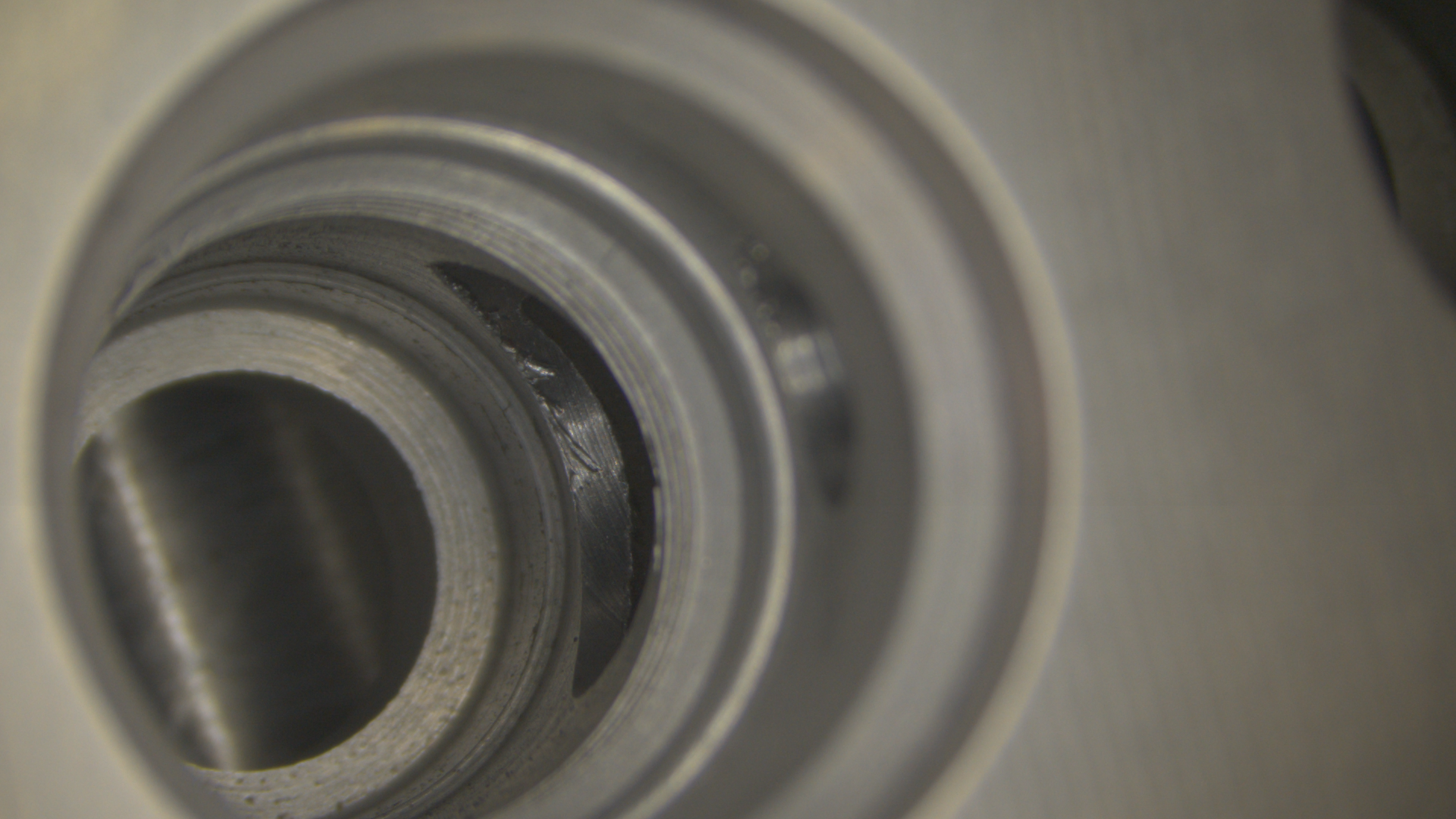
Traditional deburring methods are insufficient for modern aerospace hydraulic components due to the complexity of internal geometries. Hydraulic manifolds, servo valves, actuator bodies, and pump housings often cannot be properly processed using manual tools, brushes, mechanical cutting methods, or high-pressure washing.
As a result, these approaches fail to ensure repeatability, controlled edge geometry, optimized internal flow, and consistent surface quality.
Extrude hone finishing technologies for aerospace hydraulic systems
Extrude Hone offers complementary technologies designed to optimize aerospace hydraulic components based on geometry, material, and performance requirements.
| Technology | Functional principle | Primary application | System-level engineering impact |
|---|---|---|---|
| Abrasive Flow Machining (AFM) | Viscoelastic abrasive media flows through internal passages to mechanically refine surfaces and edges | Hydraulic manifolds, valve bodies, landing gear components | Stabilizes internal flow architecture, reduces turbulence propagation, improves circuit efficiency |
| Electrochemical machining (ECM) | Controlled anodic dissolution removes material without mechanical stress | High-precision manifold geometries, conductive aerospace alloys | Preserves dimensional integrity, eliminates stress introduction, improves sealing consistency |
| Thermal deburring (TEM) | Controlled thermal reaction removes burrs in enclosed cavities simultaneously | High-volume hydraulic housings, pump bodies, complex assemblies | Increases production scalability while ensuring uniform internal cleanliness |
| Microflow | Low-viscosity abrasive media conditions micro-passages and metering features | Servo valves, orifices, flow restrictors | Improves metering accuracy and flow repeatability in precision hydraulic control |

Aerospace system impact and system-level benefits
Across aerospace hydraulic systems, these improvements translate into more stable, efficient, and predictable operation of critical aircraft functions, including landing gear deployment, braking systems, flight control actuation, and emergency hydraulic response.
Beyond individual components, precision finishing strengthens the hydraulic system as a whole. It improves overall reliability by reducing internal variability and ensuring more consistent fluid behavior across the entire hydraulic circuit.
By minimizing internal defects, burrs and surface irregularities, these processes also enhance resistance to contamination and wear, which are key drivers of hydraulic system degradation over time.
From a manufacturing and operational standpoint, this results in hydraulic systems that require less maintenance, deliver higher availability and provide improved safety margins across commercial, military and aerospace platforms.
Extrude Hone vs conventional aerospace hydraulic suppliers
Unlike traditional hydraulic system manufacturers focused primarily on components and assemblies, Extrude Hone addresses a different layer of performance: internal functional geometry.
Where companies optimize hydraulic power generation, distribution, and component design, Extrude Hone focuses on post-machining functional conditioning of internal flow paths.
This distinction is critical in modern aerospace systems where:
- performance limits are increasingly governed by micro-scale internal defects
- system efficiency depends on flow quality, not only component design
- reliability is strongly linked to contamination and surface condition
Extrude Hone therefore acts as an enabling technology layer between machining and final hydraulic system performance.